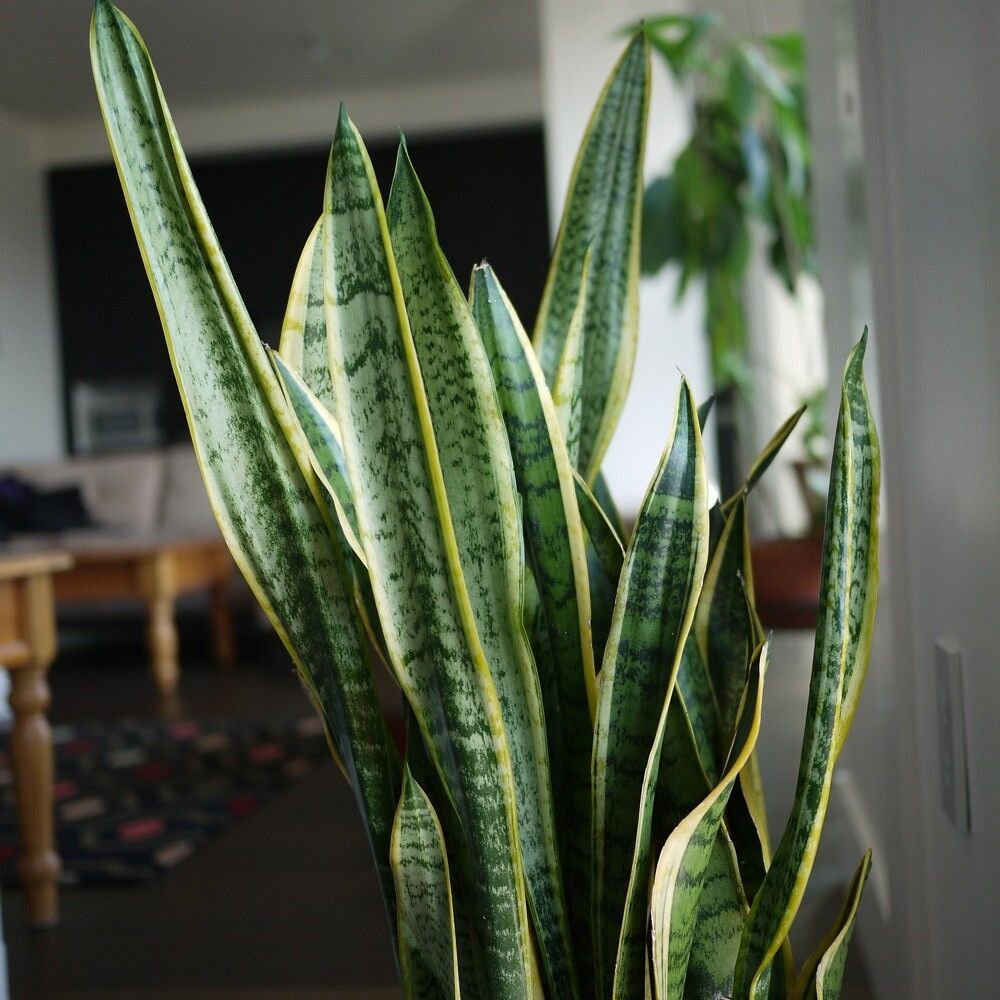
Snake plants were long called Sansevieria trifasciata; botanists have now moved them into Dracaena. Garden centers sell them under both names, and also as mother-in-law's tongue.
Snake plant care
- Light: anything from a dim corner to a bright window. Bright, indirect light makes faster growth and stronger colors.
- Water: let the soil dry out almost completely, then water deeply. That is every 2 to 3 weeks in summer and once a month or less in winter. Never let the pot stand in water.
- Soil and pot: a cactus and succulent mix in a pot with a drainage hole. Heavy clay or ceramic pots help stop tall plants tipping over.
- Feeding: once or twice in spring and summer, half strength.
- Temperature: keep above 50°F; cold, wet soil causes rot.
Common snake plant problems
| What you see | Likely cause and fix |
|---|---|
| Soft, mushy leaves or base | Root rot from overwatering. Cut away rotten parts, let healthy pieces dry, and repot in dry cactus mix. |
| Leaves falling over | Overwatering, or too little light for a long time. |
| Wrinkled, curling leaves | Too dry for too long. Water deeply once. |
| Brown, crispy tips | Uneven watering or a cold draft. |
How to propagate a snake plant
- Division (easiest): in spring, ease the plant out of its pot and cut through the rhizome so each piece has leaves and roots. Pot each piece.
- Leaf cuttings: cut a leaf into 3-inch sections, keep track of which end was down, let them dry for 2 days, then push the bottom end into moist cactus mix. Roots take 4 to 8 weeks; variegated edges are often lost this way.
Are snake plants toxic to cats and dogs?
Do snake plants clean the air?
The famous NASA study from 1989 tested plants in small sealed chambers. Later research found that in a real home you would need hundreds of plants to match what a little ventilation does. Grow a snake plant because it is beautiful and easy, not as an air purifier.
More houseplant guides
Frequently asked questions
How often should I water a snake plant?
Only when the soil is almost completely dry: every 2 to 3 weeks in summer and about once a month in winter.
Are snake plants toxic to cats?
Yes, mildly. The ASPCA lists them as toxic to cats and dogs; they can cause vomiting and diarrhea.
Can a snake plant live in low light?
Yes. It is one of the best plants for low light, though it grows slowly there.
Why are my snake plant leaves falling over?
Usually overwatering, or months in very low light. Check the base for soft, rotten tissue.